
Key takeaways
- GS1 owns the standards. This compendium makes GS1's own publications easier to find and use for fresh produce.
- One code, two readers: the register reads the data, and a phone can open the link.
- Per GS1's solution provider readiness criteria (Solution provider 2D readiness, Version 1.0.0, April 2025), converting a Digital Link to element strings at the register is expected behavior.
- For loose produce on PLU stickers, IFPA's guidance names the GTIN as the only data required for Sunrise 2027.
- The Digital Link Foundations pilot tested two code designs: a baseline built strictly to the GS1 specification, and a variant one producer designed for harsher field conditions and its own operations. The pilot team reports that the baseline codes scanned and rang up as the right item in the retail lab.
GS1 owns the standards described here. This compendium aligns with GS1 and points readers to GS1’s own publications. It paraphrases them. Where this text and a GS1 document differ, the GS1 document governs.
Summary for a brand owner
Two-dimensional (2D) barcodes hold more data than the linear barcode on most packages. GS1, the standards body behind the GTIN, has published the rules for the 2D symbols that retail point-of-sale systems are being prepared to read. Two of those symbols can carry a GS1 Digital Link, which writes the same GS1 identifiers as a web address. The register receives the identifiers as data. A phone can open the address.
For fresh produce the practical questions are: which symbol, which data, how big, how clear, and who looks after the web address if there is one. This compendium points to the GS1 and IFPA documents that answer each question. Where the published sources leave a question open, the compendium says so.
Why this matters
A package of berries moves from a grower to a packer, a distributor and a store. At the register, a linear barcode tells the system which item it is. It cannot also tell the system which batch, and it gives a shopper nothing to open. A 2D barcode can carry the GTIN and further data in a smaller space, and, in the Digital Link form, a web address as well.
The people who feel the change first are label and print teams, who must choose a symbol, a size and a print method for a sticker or a bag closure that is often only a few centimeters across. Brand owners decide what data goes in the code and who maintains any link. Retail store systems teams must make sure the scanner and software handle each symbol. Each group works from different GS1 and IFPA documents, which is why this compendium is organized by role.
The date that gives the work urgency is the end of 2027, when the industry aims for retail point-of-sale systems to read 2D barcodes. [5]
Concepts in plain language
Identification key. A number that GS1 standards use to name one kind of thing. The GTIN (Global Trade Item Number) names a trade item, such as a retail clamshell. [4]
Application Identifier (AI). A short numeric prefix that says what the data after it is. AI 01 introduces a GTIN; AI 10 a batch or lot number; AI 15 a best-before date; AI 17 an expiration date. [4]
Element string. Data written as AIs followed by values, for example a GTIN, a batch and a date in a row. A GS1 DataMatrix carries data in this form. [4]
GS1 Digital Link URI. The same identifiers written as a web address in a fixed order: domain, primary key, key qualifiers, then other data as query items. [1]
Carrier. The barcode symbol that holds the data: GS1 DataMatrix, Data Matrix, or QR Code. [6]
Resolver. A web service that receives a Digital Link address and sends the requester to a suitable destination. [3]
X-dimension, clear margin and grade. The X-dimension is the width of one module (square) of the symbol. The clear margin, also called the quiet zone, is the blank border around it. The grade is the print-quality score from verification. [10]
Sunrise 2027. GS1 US’s name for the retail move toward 2D at point of sale by 2027. GS1’s own POS guideline calls the same goal Ambition 2027. [8] [5]
1. What 2D at point of sale is and why Sunrise 2027 matters
A 2D barcode stores data in a grid of squares rather than in a row of bars. It can hold the GTIN and more, in a smaller space than a long linear code would need.
GS1’s point-of-sale guideline states the industry goal, called Ambition 2027: by the end of 2027, retail point-of-sale scanning worldwide should read and process the GTIN from both existing linear barcodes and 2D barcodes. The guideline says reaching the goal may require software upgrades and, for scanners that cannot read images, equipment upgrades. [5] GS1 US describes the same move as Sunrise 2027, a transition from 1D UPC barcodes to 2D barcodes such as QR Codes. [8] IFPA’s PLU guidance describes the milestone for produce: by the end of 2027, buyers should be able to scan and process both traditional and 2D barcodes. [10]
Sunrise 2027 is a readiness milestone for point-of-sale systems. Existing barcodes can stay on pack. IFPA’s guidance says existing UPC and EAN barcodes do not need to be replaced and that the human-readable PLU number stays on the sticker as a backup. [10]
The transition on pack
The POS guideline sets a rule for the transition. A 2D barcode cannot be the only barcode on a pack at first. A linear barcode for point of sale must accompany it until at least 90 percent of POS scanning solutions can use GS1-compliant 2D barcodes and capture the GTIN. After wide adoption, a brand may use 2D alone, 2D with the linear barcode, or the linear barcode alone. The guideline asks that the 2D barcode sit within 50 mm of the center of the linear barcode, to support target scanning speeds. [5] Many packages are therefore expected to carry both codes for a period.
Readiness criteria
GS1 also publishes readiness criteria for solution providers, so that scanners, point-of-sale software and label systems can be checked against the same list. [6] Section 4 of this compendium describes what the criteria expect of scanners.
2. The POS carriers and what each carries
GS1’s point-of-sale guideline names the 2D symbols that retail point-of-sale should support (Table 4-1 of Release 1.1.0): [5]
- GS1 DataMatrix, carrying data in GS1 element string syntax.
- Data Matrix, carrying a GS1 Digital Link URI.
- QR Code, carrying a GS1 Digital Link URI.
GS1’s readiness criteria give the same three symbols the names used in the symbol specification tables: GS1 DataMatrix (ECC 200); Data Matrix (GS1 Digital Link URI) (ECC 200); and QR Code (GS1 Digital Link URI). [6] The POS guideline says it does not repeat the exact symbol names used in the General Specifications. The wording of the carrier entries in the General Specifications, Release 26.0, is being verified before release. [5] [4]
The readiness criteria also require a point-of-sale scanner to read EAN/UPC and GS1 DataBar retail barcodes, to read both dark-on-light and light-on-dark symbols, and to be configurable to ignore non-GS1 carriers. The criteria list GS1 Composite, GS1 DotCode and the GS1 QR Code (the QR Code that carries an element string) as out of scope for point-of-sale scanners. [6]
A QR Code that carries a GS1 Digital Link URI is the symbol GS1 markets as a “QR Code powered by GS1”. A “GS1 QR Code” is a different symbol: it carries an element string. [7] [4]
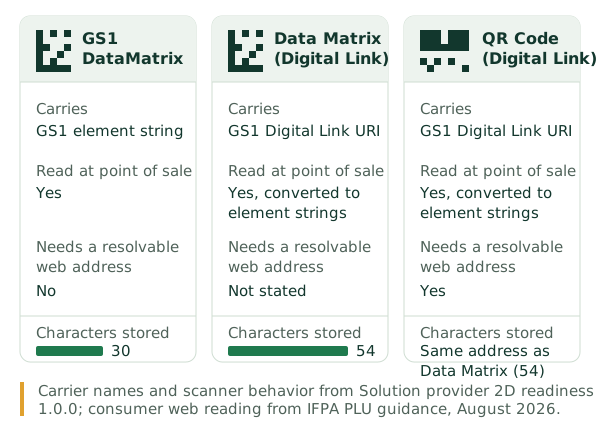
Table 1 compares the three carriers. All three carry the GTIN and further GS1 data to the register. The two Digital Link carriers also carry a web address. IFPA describes the GS1 DataMatrix as readable at point of sale but not by consumers, working with or without a web resolver and needing fewer characters, so it can be smaller. It describes the QR Code with a GS1 Digital Link as readable by consumers for web content, which requires a web address that resolves. [10] Figure 1 sets the three side by side, with the characters each worked example stores.
The three point-of-sale carriers compared. Sources: Solution provider 2D readiness 1.0.0; 2D Barcodes at Retail POS Implementation Guideline 1.1.0; IFPA PLU guidance, August 2026.
| Carrier (GS1 name) | Data structure | Read at point of sale | Consumer web reading (IFPA PLU guidance) | Needs a resolvable web address |
|---|---|---|---|---|
| GS1 DataMatrix (ECC 200) | GS1 element string | Yes, scanner must read it | Described as not readable by consumers | No; works with or without a resolver |
| Data Matrix (GS1 Digital Link URI) (ECC 200) | GS1 Digital Link URI | Yes, scanner must read it and convert the URI to element strings | Not addressed in the PLU guidance | Not stated in the sources used |
| QR Code (GS1 Digital Link URI) | GS1 Digital Link URI | Yes, scanner must read it and convert the URI to element strings | Described as readable by consumers for web content | Yes, the address must resolve |
3. Element strings and Digital Link URIs: one code, two readers
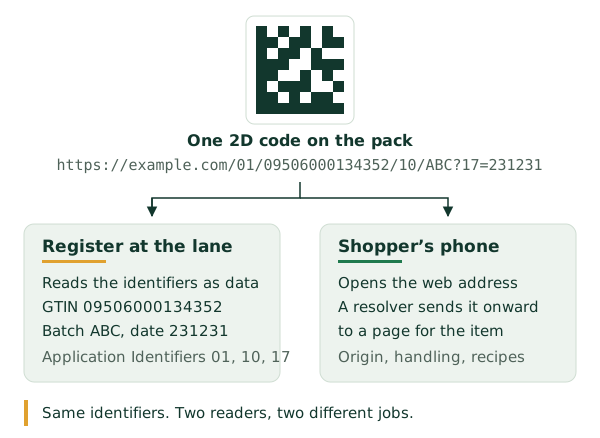
Before Digital Link, GS1 barcodes carried identifiers as an element string: each piece of data is an AI followed by its value. A GS1 Digital Link writes the same identifiers as a web address, in a fixed order: the primary key (for example the GTIN), then key qualifiers (for example a batch or lot), then other data as query items. [1] The two forms hold the same data. They differ in who can use them:
- The register is built to receive Application Identifiers. It needs the GTIN and any other data in element string form.
- A phone or partner system can open the web address, and a resolver can send it to a page that suits the person who asked.
That is the idea behind “one code, two readers”. Figure 2 shows it.
A worked example for each carrier
The three examples use the sample data in GS1’s readiness criteria: GTIN 09506000134352, batch ABC, and the date field AI 17 with value 231231 (31 December 2023 in YYMMDD form). [6] The domain example.com stands in for a brand owner’s own domain.
Example A. GS1 DataMatrix. The symbol stores the element string. In bracketed form, for reading: (01)09506000134352(10)ABC(17)231231. The stored data has no brackets. AI 10 has a variable length, so a group separator character marks the end of the batch before the next AI. GS1 shows that separator as a caret in its example: [6]
010950600013435210ABC^17231231That is 30 characters, counting the separator as one.
Example B. Data Matrix carrying a GS1 Digital Link URI. The symbol stores the web address as text: [1]
https://example.com/01/09506000134352/10/ABC?17=231231That is 54 characters in this sample, with a short domain. A longer domain adds characters, and more characters make a larger symbol for the same print resolution. [10]
Example C. QR Code carrying a GS1 Digital Link URI. The stored text is the same web address as Example B, and the symbol is a QR Code. A phone camera can open it directly. A point-of-sale scanner reads it and converts it to the element string in Example A. [6]
GS1 describes a canonical form of the address that uses the domain id.gs1.org. A brand owner may use its own domain. In both cases the identifiers in the path and query are the same, so a system can extract the GTIN, batch and date from the address without any lookup. [1]
What goes into the code
The POS guideline names the GTIN as the core data. Additional data such as batch or lot, expiry date or serial number is optional. The guideline advises encoding only the data that must be captured and acted on at the point of sale, and holding other data, such as country of origin, as linked information or in master data. [5] The guideline’s table of common retail AIs includes 01 (GTIN), 10 (batch or lot), 11 (production date), 13 (packaging date), 15 (best before), 17 (expiration) and 21 (serial number). [5]
4. How scanners convert a Digital Link URI to element strings, and why the register keeps the data and not the URL
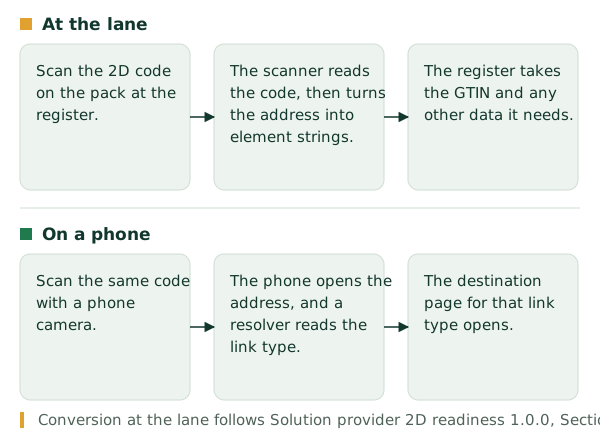
GS1’s readiness criteria describe what a point-of-sale scanner must do with each carrier. It identifies whether the symbol carries an element string or a Digital Link URI, and it converts the Digital Link URI to GS1 element string syntax. It then transmits the GTIN, and any additional data such as batch or expiry, in element string syntax. [6]
The criteria describe three scanner modes: [6]
- Mode 1 signals and transmits the first GTIN captured from either a linear or a 2D barcode, then waits for the next scan.
- Mode 2 gives priority to GS1 2D barcodes, and transmits linear barcode data if no 2D barcode is found. Its output is the GTIN plus any additional data in element string syntax.
- Mode 3 reads all GS1 retail barcodes in one scan and adds an eight-digit label identification before the barcode data, shown in both plain and element string syntax.
The retailer can configure the output to the GTIN alone or to the GTIN plus additional data, from one or all GS1 barcodes. [6] The scanner returns its result within set times: 300 milliseconds for high-speed bioptic scanners and 500 milliseconds for presentation and activated handheld scanners, measured from when the symbol enters the field of view. [6]
Why the register keeps the data and not the URL. The register’s job is to identify the item and price it. Point-of-sale systems are built around the GTIN and other Application Identifiers, and the readiness criteria describe the scanner’s output to them as element strings. The criteria describe no step that passes the web address on to the register. The domain and path of the address matter to the second reader: a phone camera or partner system that opens the whole address. A Digital Link symbol at a lane is therefore read as data, and the same symbol elsewhere is opened as a link. [6]
Data that a register or a later system needs, such as a batch or a date, belongs in the Application Identifiers of the code. A web address is the second reader’s path to more information. Plan the two separately.
The POS guideline adds that not all imaging scanners can read 2D barcodes, so retailers should consult their point-of-sale solution providers about their own equipment. [5] Figure 3 shows both flows from a single scan.
5. Resolvers: what the GS1-Conformant Resolver Standard covers
A resolver is a web service that receives a Digital Link address and sends the requester to a suitable destination. GS1 publishes the GS1-Conformant Resolver Standard, currently Release 1.2.1 (August 2026), which sets out what a resolver must do to be conformant. [3]
The standard covers how a resolver reads a GS1 Digital Link URI, how it chooses among several possible destinations for the same item, how it handles a request that names no preference, and how it describes itself to others. The main ideas are these:
- A link type names the kind of destination a requester wants, for example product information or traceability information. [3]
- A default link answers a request that names no link type. [3]
- A linkset is a machine-readable list of the links a resolver holds for an item. [3]
- A Resolver Description File lets a resolver describe its own capabilities. [3]
The register reads the data in the code without a resolver. A resolver serves the second reader, a phone or a partner system. Whether and how to operate one is a decision for the brand owner or its service provider, and the standard is the place to check what conformance would require. [3] IFPA’s PLU guidance asks that a company using a QR Code make sure the address resolves. [10]
6. Fresh produce specifics: PLU and 2D guidance, batch and dates
The International Fresh Produce Association (IFPA) published Global Implementation Guidance for 2D Barcodes on Fresh Produce PLU Stickers in August 2026, with GS1 member organizations and GS1 Global. [10] This section summarizes it. The document itself holds the full rules.
Which symbols. The guidance describes two symbols for PLU stickers: GS1 DataMatrix, and QR Code with a GS1 Digital Link. A company that is not linking to a web page is advised to use a GS1 DataMatrix. A company that uses a QR Code is advised to confirm the address resolves. [10]
Which data. The GTIN (AI 01) is the only data required in the code for Sunrise 2027, and the human-readable PLU number stays on the label. Batch or lot (AI 10), pack date (AI 13) and serial number (AI 21) are described as optional and for future use. Batch or lot and pack date typically need print-on-demand systems. Adding data increases the symbol’s size. [10]
GTIN granularity. Brand owners are asked to assign GTINs at the same level of detail as the PLU code (commodity, variety, size group). Private-label brand owners supply GTINs to the producer. A company without a GS1 company prefix is directed to its GS1 member organization. [10] GS1 publishes a GTIN Management Standard decision tool for assigning GTINs. [9]
Master data. Buyers load GTINs and PLU data into master data before product arrives in store. An item missing from master data reads as not on file at the register. [10]
Size, clear margin and print. Table 2 sets out the figures published in the guidance, the POS guideline and the readiness criteria. The IFPA guidance gives an X-dimension of 0.396 mm minimum, 0.495 mm target and 0.990 mm maximum, and a smallest typical sticker of an oval about 21 by 17 mm. It asks for a minimum symbol grade of 1.5 confirmed by verification, black on white, and no colored, high-gloss or metallic stock. It notes that scannability through produce bags has not been verified, and that clear bags scan more reliably. [10]
Symbol size and clear margin as published. Sources: IFPA PLU guidance, August 2026; 2D Barcodes at Retail POS Implementation Guideline 1.1.0; Solution provider 2D readiness 1.0.0.
| Source | X-dimension (mm): minimum / target / maximum | Clear margin (quiet zone) | Minimum quality |
|---|---|---|---|
| IFPA PLU guidance, Aug 2026, all PLU sticker symbols | 0.396 / 0.495 / 0.990 | At least 4X on all four sides | Symbol grade 1.5, confirmed by verification |
| POS guideline 1.1.0, QR Code | Per symbol specification tables 1 and 3 | 4X on all four sides | Per symbol specification tables |
| POS guideline 1.1.0, Data Matrix | Per symbol specification tables 1 and 3 | 1X on all four sides | Per symbol specification tables |
| Readiness criteria 1.0.0, table 1 (general retail POS, not general distribution), all three carriers | 0.396 / 0.495 / 0.990 | 1X on all four sides | 1.5/12/660 (grade, aperture, wavelength) |
| Readiness criteria 1.0.0, table 3 (general retail POS and general distribution), all three carriers | 0.743 / 0.990 / 0.990 | 1X on all four sides | 1.5/12/660 (grade, aperture, wavelength) |
The clear margin for a QR Code is four times the X-dimension in the POS guideline and in IFPA’s guidance, and one X-dimension in the symbol specification table rows shown in the readiness criteria. For Data Matrix, the POS guideline and the readiness criteria both give one X-dimension. See open question 3. [5] [10] [6]
Who does what. Marketers confirm trading partners’ plans and agree the symbol with the label maker. Label suppliers are engaged at the start, to plan equipment and label sizes. Buyers upgrade and test point-of-sale systems and update supplier requirements. [10]
7. What the Digital Link Foundations pilot tested: two code designs
The pilot
The Digital Link Foundations pilot looked at one question in two steps. First, can a 2D code on a produce package scan at a real point of sale and ring up correctly? SCOTF called this “getting the beep”. Second, once a code scans, what else can it carry or point to: a lot, a pack date, an origin, and a web link to product and condition information? The second step was scoped as a concept and is not being built further in 2026. [15]
Participants were Driscoll’s, with a clamshell label, and Stemilt, with a bag closure label made with Kwik Lok. Codes were tested on a limited set of items in a retail point-of-sale lab. The lab is not named in this compendium. [15]
Two code designs
The pilot tested two designs side by side.
- Baseline: codes built strictly to the GS1 specification, carrying the GTIN and the appropriate Application Identifiers for attribute data.
- Variant: a design one participating producer developed to explore the wider return on 2D barcodes, from production and harvest through shipping and transport to retail. It carries the same data as the baseline, with a different physical design: a larger symbol and other changes the producer found more reliable in harsher field environments. The producer also wanted the code to serve its own operations, alongside the external uses a Digital Link supports.
The variant was a deliberate experiment in how the physical design of a code can be adapted to field and operational needs.
What the lab found
The pilot team reports that the baseline codes scanned in the retail point-of-sale lab and rang up as the right item. Results for the variant design are not yet published and will be added from the lab report once it is cleared. This compendium ties neither design to a named company.
Table 3 sets out the results by design.
Pilot lab results as reported by the pilot team. Variant results are pending the cleared lab report.
| Code design | Built to | Scanned in the retail POS lab | Rang up as the correct item | Note |
|---|---|---|---|---|
| Baseline | GS1 specification, with the appropriate AIs | Yes | Yes | Detail for each carrier and label type to be added from the lab report. |
| Variant (one participating producer) | Same data as the baseline; physical design adapted for field reliability and the producer’s operations | Results pending | Results pending | To be added from the lab report once cleared. |
What the results mean for you
In the pilot team’s view, build the baseline to the GS1 specification first, and verify it before a label run is printed. If you change a code’s physical design for your own operations, test the changed design on the retailer’s class of scanner before you rely on it at the register. IFPA’s guidance asks for verification of printed codes to a minimum grade of 1.5. [10]
Limits of the pilot
The pilot used a limited set of items, one retail lab and the scanners in it. Its results describe those tests. They do not describe every scanner, label stock or print method, and the pilot did not test the web-link step at scale. Results for the variant design are pending. [15]
Before printing a label run, verify a sample against the symbol requirements in the GS1 General Specifications and the symbol specification table in the readiness criteria, then scan it on the same class of scanner the retailer uses.
8. Case studies GS1 has published
GS1 has published case studies of 2D barcodes in retail. The figures below are as GS1 reports them. SCOTF has not independently verified them. Companies are described by country and sector, with the GS1 citation. Barcode type is given where the source states it.
A gourmet food shop in Brazil. The shop replaced manual processes with an automated system connecting its enterprise resource planning and point-of-sale software. Its products carry a QR Code that contains a GS1 Digital Link. GS1’s case page gives no measured results. [12] GS1’s retailer stories page summarizes the outcome as better inventory accuracy and less food waste through expiry date management. [11]
A convenience-store chain in Poland. GS1’s case describes a GS1 DataMatrix carrying the GTIN, batch or lot, expiry date and serial number on private-label fresh food, starting in 2023 with soups and salads across more than 11,000 stores. The chain had adopted GS1 DataBar barcodes in 2018. GS1 reports benefits in restocking, scan accuracy on small and curved packages, expiry tracking and recalls, and a 47 percent rise in franchisee satisfaction in a 2023 survey. It describes plans to extend the barcode to fresh produce. [13]
A national supermarket chain in Australia. GS1 reports that the chain and selected suppliers use 2D barcodes built on GS1 standards, with food waste reduced by up to 40 percent, alerts to cashiers when a scanned item is past its expiry, and a plan to link shoppers to traceability information. [14] GS1’s retailer stories page reports a productivity improvement of up to 21 percent for expiry date management. [11] The two pages report different measures, and neither names the specific barcode type.
A grocery group in Norway. GS1’s retailer stories page reports an 18 percent reduction in waste in a pilot on the group’s own brands. [11]
A provincial food traceability program in China. The same page reports that, in 2022, shoppers scanned QR Codes powered by GS1 in 5,200 retail stores, covering 67,000 food companies and 111 million consumers. [11]
Further GS1 case studies are being checked and are not yet included.
9. Where to go next: GS1 resources by role
Table 4 lists the GS1 and IFPA publications by role, with the version used in this compendium. Build against the version that is current when you read it.
GS1 and IFPA publications by role.
| Role | Publication | Version used here | Link |
|---|---|---|---|
| All roles | GS1 Digital Link (overview) | Web page | gs1.org/standards/gs1-digital-link |
| All roles | GS1 Digital Link URI Syntax | Release 1.7.0, Aug 2026 | ref.gs1.org/standards/digital-link/uri-syntax |
| Brand owners and packers; labeling and print providers | IFPA, Global Implementation Guidance for 2D Barcodes on Fresh Produce PLU Stickers | Aug 2026 | ifpsglobal.com, implementation guide (PDF) |
| Brand owners and packers | GTIN Management Standard decision tool | Web tool | gs1.org, GTIN decision support |
| Brand owners; labeling and print providers | QR Code powered by GS1, best practices | 2023 | ref.gs1.org, QR Code best practices |
| Labeling and print providers; brand owners | GS1 General Specifications (symbol specifications, symbol specification tables) | Release 26.0, Jan 2026 | ref.gs1.org/standards/genspecs |
| Retail store systems and POS | Solution provider 2D readiness | Version 1.0.0, Apr 2025 | ref.gs1.org/sme-guidance/solution-provider-2d-readiness |
| Retail store systems and POS | 2D Barcodes at Retail Point-of-Sale Implementation Guideline | Release 1.1.0, Dec 2025 | ref.gs1.org/guidelines/2d-in-retail |
| Technology and resolver operators | GS1-Conformant Resolver Standard | Release 1.2.1, Aug 2026 | ref.gs1.org/standards/resolver |
| All roles | What is GS1 Sunrise 2027? (GS1 US) | Web page | gs1us.org, Sunrise 2027 |
How to use this compendium
Work through the list for your role. Each item points to the section that explains it.
Brand owners and packers
- Confirm your GTIN granularity matches the PLU code (commodity, variety, size group), or the pack, for packaged items. (Section 6)
- Choose the carrier: GS1 DataMatrix if you are not linking to a web page; QR Code with a GS1 Digital Link if you want a link that resolves. (Sections 2 and 6)
- Decide the data: the GTIN is the minimum for PLU stickers; add batch, pack date or serial number only if you need them and your print system can produce them. (Sections 3 and 6)
- Verify printed samples to a minimum grade of 1.5. (Section 6)
- Test on the retailer’s scanner class and confirm how the retailer sets scanner output. (Section 4)
- If you encode a web address, name who will keep it resolving and for how long. (Section 5)
Retail store systems and POS teams
- Check scanners and software against the readiness criteria: carriers read, reflectance, conversion of the Digital Link URI. (Sections 2 and 4)
- Set the scanner output mode (1, 2 or 3) and whether it passes the GTIN alone or the GTIN plus additional data. (Section 4)
- Load GTINs and PLU data into master data before product arrives. (Section 6)
- Keep linear barcode support during the transition. (Section 1)
Labeling and print providers
- Agree the symbol with the brand owner at the start of the project. (Section 6)
- Set the X-dimension within the published range and the clear margin for the chosen symbol, and note the open question on the QR Code margin. (Table 2)
- Print black on white on non-glossy stock, and verify each run. (Section 6)
- Place the 2D barcode within 50 mm of the center of the linear barcode where both are used. (Section 1)
10. Open questions the industry is raising
These are the questions the industry is raising, drawn from the sources above and from the pilot.
- Who operates and maintains the web address behind a QR Code on a produce sticker, and for how long? What should a shopper or buyer see if the address stops resolving?
- When a code carries only the GTIN, what is the case for adding batch or pack date, given that doing so enlarges the symbol and needs print-on-demand equipment? [10]
- What clear margin should a QR Code with a Digital Link carry on a small sticker, given that the POS guideline and IFPA state four times the X-dimension and the readiness criteria’s symbol specification table rows show one? [5] [10] [6]
- How should a code on a produce bag be verified, given that IFPA notes scannability through bags has not been verified? [10]
- How will retailers configure scanner output (GTIN only, or GTIN plus additional data) across stores, and how will brand owners learn which they use? [6]
- How long will the period of carrying both linear and 2D codes last, and who decides when a linear barcode can be dropped, given the 90 percent threshold in the POS guideline? [5]
- How will brand owners check that field-printed codes conform before they reach a lane, and who offers that check?
- Where a producer adapts the physical design of a code for harsher field conditions or its own operations, how should it check the adapted code against GS1’s symbol specifications and the retailer’s scanners, and how does GS1 guidance treat such variants? [4] [6]
References
- GS1 (2026). GS1 Digital Link URI Syntax. Release 1.7.0, August 2026. https://ref.gs1.org/standards/digital-link/uri-syntax/
- GS1 (n.d.). GS1 Digital Link. Web page. https://www.gs1.org/standards/gs1-digital-link
- GS1 (2026). GS1-Conformant Resolver Standard. Release 1.2.1, August 2026. https://ref.gs1.org/standards/resolver/
- GS1 (2026). GS1 General Specifications. Release 26.0, January 2026. https://ref.gs1.org/standards/genspecs/
- GS1 (2025). 2D Barcodes at Retail Point-of-Sale Implementation Guideline. Release 1.1.0, ratified December 2025. https://ref.gs1.org/guidelines/2d-in-retail/
- GS1 (2025). Solution provider 2D readiness. Version 1.0.0, April 2025. https://ref.gs1.org/sme-guidance/solution-provider-2d-readiness/
- GS1 (2023). QR Code powered by GS1, best practices. 2023. https://ref.gs1.org/docs/2023/QR-Code_powered-by-GS1-best-practices
- GS1 US (n.d.). GS1 Sunrise 2027. GS1 US overview page. https://www.gs1us.org/industries-and-insights/by-topic/sunrise-2027
- GS1 (n.d.). GTIN Management Standard decision tool. Web tool. https://www.gs1.org/1/gtinrules/en/decision-support
- IFPA (2026). Global Implementation Guidance for 2D Barcodes on Fresh Produce PLU Stickers. August 2026. https://www.ifpsglobal.com/s/2D-Barcode-PLU-Implementation-Guide_FINAL-hgmn.pdf
- GS1 (2024). Retailers, next generation barcodes implementation success stories. June 2024. https://www.gs1.org/sites/gs1/files/2024-06/retailers-next-generation-barcodes-implementation-success-stories.pdf
- GS1 (n.d.). Case study, a gourmet food shop in Brazil uses a GS1 Digital Link in a QR Code. Web page. https://www.gs1.org/insights-events/case-studies/brazilian-gourmet-shop-scans-worlds-first-2d-barcode-gs1-digital-link
- GS1 (n.d.). Case study, GS1 DataMatrix on private-label fresh food in a convenience-store chain in Poland. PDF, rollout from 2023. https://www.gs1.org/system/files/case_study_gs1-poland-zabka-nowalijka.pdf
- GS1 (n.d.). Case study, 2D barcodes at a national supermarket chain in Australia. Web page. https://www.gs1.org/insights-events/case-studies/woolworths-australia-seeing-multiple-benefits-2d-barcodes
- SCOTF (2026). Pilot Scope Memos, 2026 Pilot Series. Unpublished deliverable.
About this artifact
Contributor disclosure
GS1 owns the standards described here. This compendium paraphrases and links to GS1 and IFPA publications and aligns with them. Where this text and a GS1 publication differ, the GS1 publication governs. GS1 has not endorsed this compendium.
© 2026 the contributors. GS1 Digital Link for Fresh Produce: A Compendium of GS1 Guidance is licensed under the Creative Commons Attribution-NonCommercial 4.0 International license. Share and adapt it for non-commercial purposes, with attribution. Attribute the contributors and Supply Chain of the Future. Listing a company, product or tool is not an endorsement.
This is a v0.9 community release from the Supply Chain of the Future (SCOTF) initiative, an industry innovation program. It is shared to support industry learning and is open for comment at hello@scotf.org.