
Key takeaways
- The traceability label already on the case is the key that joins quality records across companies: one outbound inspection and one arrival check meet on the same label identifiers.
- Keep the restaurant step simple: a target of about 90 seconds, done by restaurant staff, with one question and one photograph.
- The target is to cut complaint investigations from days to minutes; Phase 1 measures it.
- Phase 0, the supplier's digital outbound inspections at one facility, is described here as the supplier's own account, and the results will separate that earlier improvement from the effect of sharing data.
- Start with Phase 1: one supplier, a few restaurants, one shared record.
Why quality visibility matters in food service
The traceability label already on the case is the key that joins quality records across companies. Pilot 2 of the 2026 SCOTF pilot series tests that idea on one commodity and one lane: ripened avocados moving from a supplier to selected restaurant locations, with a digital inspection at the supplier’s dock and a short arrival check at the restaurant door. The label on the case joins the two records.
Product that leaves a supplier’s distribution center moves through distribution into food service with little structured inspection or feedback at the receiving end. In the pilot team’s view, problems then surface late, as complaints, and each side argues backward from its own account of the product. The supplier may hold an inspection record, but it sits in paper files or in a system the customer cannot see. The restaurant may hold photographs, but they arrive without the supplier’s record of the product at shipment. A complaint investigation becomes a search for records and then a comparison of two accounts.
The scale of the problem is large even though no single number describes it for restaurants. USDA’s Economic Research Service estimated that 31 percent of the food supply available at the retail and consumer levels in the United States went uneaten in 2010, 133 billion of 430 billion pounds [8]. That figure covers all foods and the retail and consumer levels, so it frames the stakes and does not measure this lane. What happens when a delivery is in doubt is better documented. In US produce trade, the Perishable Agricultural Commodities Act expects product to arrive in suitable shipping condition, also called good delivery, meaning without abnormal deterioration under normal transport. A buyer who wants to reject has to do so in time and give notice; unloading or diverting the product, or failing to tell the seller, counts as acceptance. A party that cannot settle a dispute can file an informal complaint with USDA within nine months [9]. This is a summary for orientation, not legal advice; the USDA Agricultural Marketing Service sets out the rules.
Those rules make the record at the moment of delivery important. A claim usually turns on two questions: what condition the product was in when it left, and what condition it was in when it arrived. In practice the answers sit in two places, the supplier’s inspection and the restaurant’s photographs, and each side starts from its own. What a credit or a claim costs depends on contracts that SCOTF does not publish, so this report gives no cost figure. It treats the time and effort spent reconciling two accounts as the cost the pilot sets out to reduce.
A shared condition record changes the starting point. Both sides look at the same label identifiers, retrieve the supplier’s outbound inspection and the restaurant’s arrival check, and compare what was recorded at shipment with what was recorded at the door. The target is to cut complaint investigations from days to minutes; Phase 1 measures it.
The pilot tests one question: does a shared condition record, from supplier outbound to restaurant arrival, speed complaint resolution and reduce complaints? It follows the idea behind the whole 2026 series: trusted product-condition data, captured once and shared by role, can change decisions before a problem reaches the customer. It uses open standards and keeps each participant in control of its own data.
Who takes part
Table 1 lists the participants by role. Companies appear by name where they have approved it. The restaurant customer is not named and is not described further.
Participants and roles
| Role | Participant | What it does in the pilot |
|---|---|---|
| Supplier | Del Monte | Ripens avocados and performs digital outbound inspections after ripening |
| Digital inspection platform | Clarifresh | Hosts inspections, photographs and arrival checks in one cloud record |
| Restaurant customer | A food service customer (not named) | Staff at selected locations perform a simple arrival check |
| Food service distributor | To join in Phase 2 | Captures condition at receipt and at outbound shipment |
| Facilitator | SCOTF, through its technical lead | Defines the shared event model and the success measures, and documents the results |
SCOTF endorses no vendor. Naming a company here describes its role in the pilot and is not an endorsement.
What this report covers
This is version 0.9, a draft for industry comment. It covers:
- the concepts you need, in plain language;
- what the supplier has done so far (Phase 0);
- the two capture points of Phase 1 and the four of Phase 2;
- how the restaurant check is designed to stay short;
- how success is measured and how the program’s effect is separated from other changes;
- a checklist for starting your own pilot, and the questions the industry still has to settle.
Phase 1 results are not yet available. The outcome figures in this report are design targets: the 90-second arrival check and cutting complaint investigations from days to minutes.
Concepts in plain language
This section defines the terms the rest of the report uses. If you already work with GS1 identifiers and EPCIS, you can skip to What has been done (Phase 0).
Digital inspection
A digital inspection is a structured inspection captured on a device at the time of the inspection. It has defined fields, and photographs attach to the record directly. The record is available for review as soon as it is submitted, with no paper to scan and no photographs to attach separately.
Ripeness stage
Ripeness is the quality attribute that moves fastest for an avocado, and it is the one a restaurant is most likely to dispute: product that is too hard cannot be used that day, and product that is too soft is discarded. Published research on Hass avocados examines how maturity at harvest and ripening affect aroma and flavor, and how cold storage before and after ripening affects quality and sensory attributes [11][10]. The pilot does not set its own ripeness scale in this report. It records the stage on the supplier’s existing scale, so the number means the same thing at shipment and in any later comparison.
Ripened avocados ship at a stage of ripeness. Ripeness stage is the supplier’s statement of how far the fruit has ripened when it leaves. In the pilot team’s view it is the practical link to remaining shelf life for ripened fruit: fruit shipped further along has less time before it needs to be used, so the stage tells the receiver how soon to use it. The pilot records the stage at outbound inspection (Table 2). It does not use a shelf-life model and works from the recorded stage.
The traceability label as the join key
Every case already carries a traceability label with GS1 identifiers. Two records about the same product can be joined only if both carry the same identifier. The pilot uses the identifiers already on the label as the join key, so neither the supplier nor the restaurant adds a label or new hardware.
The identifiers on the label set the grain of the match. GS1 separates identifiers that name exactly one object, such as an SSCC for a pallet, from identifiers that many objects share, such as a GTIN with a lot number [4]. A match on a shared identifier shows that the arrival check and the outbound inspection concern the same lot. A match on a one-object identifier shows they concern the same case or pallet. The grain affects how far back a single complaint can be traced.
Produce already has a common label format. The Produce Traceability Initiative’s best practices for case labels, revision 2.2, call for a GS1-128 barcode that carries the GTIN, the batch or lot number, and a pack or best-by date, with the GTIN and lot also printed in human-readable form below the barcode [7]. The GTIN and the lot are defined by the GS1 General Specifications [5]. A GTIN with a lot identifies a class of cases packed together. It does not identify one case. If the label carries a serial identifier or an SSCC, the match can name one case or pallet. The same identifiers can also be written as GS1 Digital Link web addresses, which is useful when a record is shared as a link [6]. Which identifiers the pilot’s cases carry is to be confirmed with the supplier, and this report does not assume that they follow the PTI format.
EPCIS 2.0 observation events
EPCIS is the GS1 standard for sharing records of what happened to identified things [3]. One EPCIS event records the completion of one business step along five dimensions: what, when, where, why and how [4]. An inspection fits this directly. The guideline lists inspecting among its example business step values, and it describes an ObjectEvent with the action OBSERVE as the form for an event that neither starts nor ends an object’s life [4].
In the pilot, each outbound inspection and each arrival check is mapped to an EPCIS 2.0 observation with quality attributes, keyed to the label’s GS1 identifiers. The mapping lets the same pattern run on any inspection platform. EPCIS gives places for the values. A sensor report can carry a measured value such as a temperature, and it can carry a text value [4]. For values the standard does not define, EPCIS 2.0 supports user extensions in its JSON-LD syntax (section 5.8 of the guideline) [4]. The exact mapping is being settled with the platform provider. This report describes the pattern. GS1 publishes a JSON Schema for checking EPCIS events, and teams can use it to test their own [1].
An illustrative observation event
The sketch below shows where the values in an outbound inspection can sit in an EPCIS 2.0 event. It is illustrative. The identifiers use the GS1 documentation prefix 0614141, and the lot, location, values and the extension namespace are invented. The event validates against the GS1 EPCIS 2.0 JSON Schema. The schema does not check units of measure against the UN/CEFACT code lists, and it does not check that an extension namespace is declared in the document context, so check both yourself. The exact mapping is still being settled with the platform provider. Test your own events with the GS1 schema [1].
{
  "@context": [
    "https://ref.gs1.org/standards/epcis/2.0.0/epcis-context.jsonld",
    { "example": "https://example.org/epcis-ext/" }
  ],
  "type": "EPCISDocument",
  "schemaVersion": "2.0",
  "creationDate": "2026-10-23T12:00:00.000Z",
  "epcisBody": {
    "eventList": [
      {
        "type": "ObjectEvent",
        "eventTime": "2026-10-23T09:30:00.000-07:00",
        "eventTimeZoneOffset": "-07:00",
        "action": "OBSERVE",
        "bizStep": "inspecting",
        "disposition": "conformant",
        "readPoint": { "id": "urn:epc:id:sgln:0614141.00001.0" },
        "quantityList": [
          {
            "epcClass": "urn:epc:class:lgtin:0614141.012345.L2610",
            "quantity": 48,
            "uom": "C62"
          }
        ],
        "sensorElementList": [
          {
            "sensorReport": [
              { "type": "Temperature", "value": 5.5, "uom": "CEL" }
            ]
          }
        ],
        "example:ripenessStage": "3",
        "example:defects": [
          { "example:defectType": "bruising", "example:unitsAffected": 2 }
        ],
        "example:photoRef": "https://example.org/photos/L2610-dock-01.jpg"
      }
    ]
  }
}
Reading the sketch: the event is an ObjectEvent with the action OBSERVE, the business step inspecting and the disposition conformant, all taken from the CBV [2]. The cases are named by a GTIN-and-lot class identifier with a count, which matches the grain a GTIN and lot can give. If the label carries a serial identifier, the event would list those identifiers instead. The temperature rides in a sensor report, in degrees Celsius. Ripeness stage, defects and the photograph have no defined place in the standard, so the sketch puts them in user extensions under a namespace declared in the document context. This keeps the standard unchanged, and any compliant system can read the event and pass the extensions through. A sensor report can also carry text and web-address values, and the platform mapping may use that route for some fields [4]. The restaurant’s arrival check has the same shape: the same class identifier, the business step inspecting, and a disposition and photograph reference recorded by restaurant staff. The shared identifier is what lets a receiving system line the two events up.
What has been done (Phase 0)
Phase 0 is the groundwork that came before the shared record. The supplier strengthened its post-ripening outbound quality program. It added internal oversight, and it began digital outbound inspections on the platform at one facility. The supplier states that service levels across the program have improved since it increased that focus. This is the supplier’s own assessment, and this report shows no measurement of it.
Two things changed in practice. First, inspections are available for review as soon as they are submitted, without scanning paperwork or attaching photographs separately. Second, when a restaurant complaint arrives, the traceability information on the case label retrieves the matching outbound inspection. The supplier describes this retrieval as taking seconds. The pilot has not yet timed it, and Phase 1 will. The supplier can then compare the documented condition at shipment directly with the complaint and the restaurant’s photographs. Before the digital inspections, the records were on paper, and the pilot uses that paper process as the baseline for retrieval time. Figure 1 shows the retrieval path before and after.
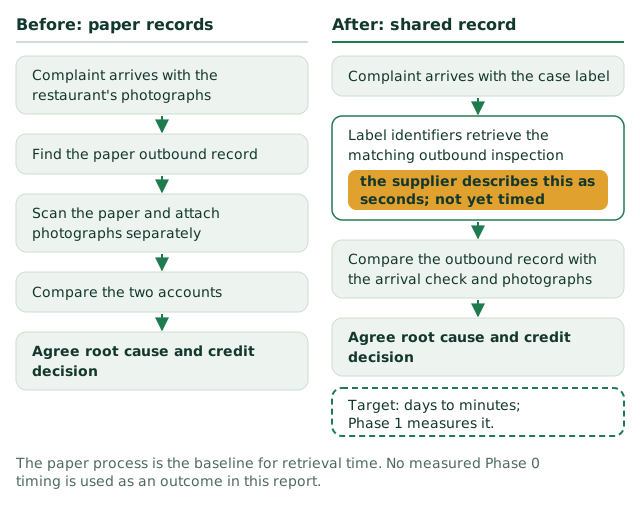
Phase 0 is an observation, and no measured timing or complaint count is used as an outcome in this report. Phase 1 supplies the measurements.
The improvement came with other changes. The supplier added oversight at the same time as the inspections, and it saw improvements beyond the one facility. The team therefore does not attribute the improvement to the digital inspections alone. This is why the success measures below separate the program’s earlier effect from the effect of sharing data.
Phase 1: supplier outbound to restaurant arrival
Phase 1 runs by December 2026 and has two capture points [12]. Figure 2 shows them.
- Supplier outbound. After ripening, the supplier inspects each shipment on the platform: ripeness stage, defects, temperature and photographs. The record is keyed to the traceability label on the case.
- Restaurant arrival. At selected locations, staff scan or enter the case label and complete a short check: is the product acceptable for use, with a photograph. The check is designed to take about a minute and a half.
- Match. The shared label identifier joins the two records in the platform’s cloud. The outbound inspection is the before, and the arrival check is the after, which gives a before-and-after view of each shipment.
No new hardware or label is required.
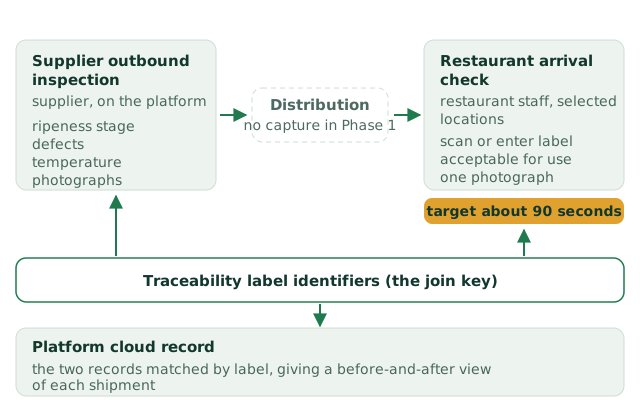
Table 2 lists the capture points and the data elements at each.
Capture points and data elements
| Capture point | Phase | Captured by | Data elements | Keyed by |
|---|---|---|---|---|
| Supplier outbound | Phase 0 (one facility) and Phase 1 | The supplier, on the platform | Ripeness stage; defects; temperature; photographs | The identifiers on the case’s traceability label |
| Restaurant arrival | Phase 1 | Restaurant staff at selected locations | Case label scanned or entered; acceptable for use; one photograph | The same label identifiers |
| Distributor inbound | Phase 2 | The food service distributor | Condition at receipt; fields to be agreed | The same label identifiers |
| Distributor outbound | Phase 2 | The food service distributor | Condition at outbound shipment; fields to be agreed | The same label identifiers |
Each record also carries the time and the place of the check, which EPCIS holds in its When and Where dimensions [4].
A worked example: one complaint, traced
The example below is illustrative. It is not pilot data, and the details are invented to show the steps. Suppose a restaurant manager reports that a case of avocados received on a Tuesday was too soft to use. In the pilot design the trace runs as follows.
- Scan the label. The restaurant’s arrival record already holds the case label identifiers and one photograph, taken at the door. The supplier’s quality team starts from those identifiers and no search by date or purchase order is needed.
- Retrieve the outbound inspection. The same identifiers return the supplier’s record for that lot: the ripeness stage on the supplier’s scale, the defects found, the temperature at inspection and the photographs taken at the dock.
- Compare the two. If the outbound record shows a ripeness stage near the soft end of the scale and the dock photographs show softening, the question is about the condition at shipment. If the outbound record shows firm product and clean photographs, the question moves to what happened between the dock and the door.
- Locate the leg. With only two capture points, the trace can say whether the change happened before or after shipment. It cannot say where on the road it happened. That is the gap Phase 2 is meant to narrow, because a distributor’s inbound and outbound checks split the road into legs.
- Record the outcome. The team notes whether the cause was condition at shipment, handling after shipment, or unclear, and keeps the outcome with the record. Recording the outcome of many complaints shows whether a practice needs to change.
In the paper process, the first two steps are a search through files and a request to the restaurant for photographs. The pilot’s measure is how long steps one to three take, from the complaint to a first answer. Phase 1 collects that time and does not assume it.
Status
As of October 2026, digital outbound inspections are live at one facility. Phase 1 is being set up with the restaurant customer’s selected locations. A technical session with the platform provider on data export and event mapping is planned for late October, and the locations and the arrival-check form are to be confirmed. Participants have confirmed that Phase 1 can be completed by December 2026. In November, Phase 1 is scheduled to run, with outbound and arrival checks, and a results summary for Phase 1 is planned for early December.
Phase 2: adding the distributor
Phase 2 begins after Phase 1 is working and is expected in 2027. A food service distributor adds two capture points, an inbound check and an outbound check. Condition then becomes visible at four points: supplier outbound, distributor inbound, distributor outbound and restaurant arrival (Figure 3).
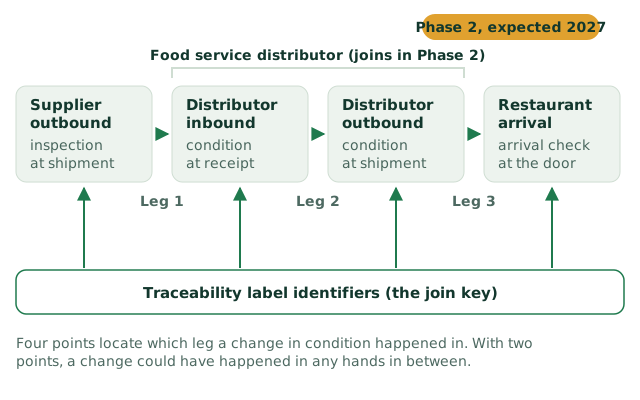
The extra points locate where in the chain a change in condition occurs. With two points, a change between shipment and arrival could have happened in any hands in between. With four, a change can be assigned to one leg of the journey. The fields the distributor records are to be agreed, and they follow the same pattern as the other capture points.
Designing the restaurant check: a 90-second target for restaurant staff
The restaurant step is intentionally simple. The aim is to capture, consistently, whether the product is acceptable at the point of use, without slowing restaurant operations. The pilot is not turning restaurant employees into quality inspectors. The supplier’s outbound inspection carries the detail on ripeness and defects.
The design target is about 90 seconds, done by restaurant staff. It is a target. The pilot has no measured check time yet, and the time has to be recorded for the target to be tested. In the pilot team’s view, the main concern about any receiving-side step is the added work at the door, so the design starts from how little the check can ask.
Table 3 sets out the design rules.
Design rules for the restaurant check
| Rule | What it means | Why |
|---|---|---|
| Use the label already on the case | Scan or enter its identifiers; add no new label | Keeps the step small and keeps the same join key at both ends |
| Ask one question | Is the product acceptable for use | Staff record a use decision they already make, and no grading skill is needed |
| Take one photograph | Attach one photograph to the check | Gives the supplier an image to set beside its outbound photographs |
| Add no hardware | Use what the pilot already uses | The pilot requires no new hardware |
| Keep to a time budget | About 90 seconds, measured | A target that can be tested rather than assumed |
| Make it useful to the person doing it | The check should make the receiver’s job easier | In the pilot team’s view, a step that helps the person doing it is more likely to be done consistently |
Success measures
The pilot answers four questions. Can issues be identified earlier? Where do changes in condition occur? Can complaints be investigated and resolved faster? Does shared visibility lead to fewer complaints and better collaboration? Table 4 lists the measures and how each is assessed.
Success measures and methods
| Measure | How it is assessed |
|---|---|
| Match rate | Share of restaurant arrival checks matched to an outbound inspection by label |
| Arrival check completion | Share of deliveries at pilot locations with a completed check |
| Complaint retrieval time | Time from complaint to retrieval of the outbound record; the baseline is paper records |
| Complaint resolution time | Time from complaint to agreed root cause and credit decision |
| Complaint rate | Complaints per thousand cases at pilot locations, compared with the prior period and with non-pilot locations |
No numeric targets are set for these measures in this version. Phase 1 will report what it measured.
Separating the program’s effect from other changes
The supplier improved its outbound program before the pilot began. A lower complaint rate at pilot locations could therefore come from that earlier work, from the season or the source of the fruit, from changes at the restaurant, or from the shared record. The results will separate the improvement that came before the pilot from the effect of sharing data. They will not attribute all of it to the pilot. Three comparisons do the separating:
- the pilot locations against their own prior period;
- the pilot locations against non-pilot locations over the same weeks;
- complaints per thousand cases, so that a change in volume does not read as a change in quality.
A small number of locations and a short run limit what these comparisons can show. If a measure cannot be separated, the report will say so and will not draw a conclusion from it.
How to start: a checklist
You can start with one supplier lane and a few restaurant locations. The first steps are agreements and a baseline. They need no new technology.
Do the first three items with your supplier QA lead and one customer this month.
Decide
- Pick one lane: one commodity, one supplier facility and a few customer locations.
- Write the question you want answered, in the form: does a shared record speed complaint resolution and reduce complaints.
- Name who owns the shared record and which fields each party can see. Each party keeps its own data and shares only what is agreed.
Set up
- List the identifiers on your case label. Decide whether a match should name a case, a pallet or a lot [4].
- Make the outbound inspection a digital record with a fixed set of fields and photographs.
- Write the arrival check as one question and one photograph. Time it with the staff who will do it, and revise it until it fits the budget you set.
- Agree how each inspection and check will map to an EPCIS 2.0 observation, and check your events against GS1’s JSON Schema [1].
Baseline and run
- Record your current complaint retrieval time, using the paper process if that is what you have.
- Record complaints per thousand cases for the prior period at your pilot locations and at comparison locations.
- Run the check at the pilot locations, and track how many deliveries have a completed check.
- After the first complaints, compare retrieval and resolution times with the baseline, and write down changes that could also explain the result.
- Write a rule for when the outbound inspection and the arrival check disagree. A starting point: the supplier’s quality lead reviews both records and both photographs within one business day of the complaint, records the outcome as condition at shipment, handling after shipment, or unclear, and tells the customer. Adjust the time and the reviewer to your contract and product.
A few locations and a short run support learning, and they do not support strong claims about cause. Report what you saw, and state what you could not separate.
Open questions
These are questions for the industry to settle.
- What should the label identify? A match on a lot traces a complaint to a batch, and a match on a case or pallet traces it further. What does a label need to carry so the match is useful and the label stays within what GS1 guidance allows?
- Where does ripeness stage end and remaining shelf life begin? Ripeness stage is a practical stand-in for ripened fruit. How should a stage be recorded so that a later shelf-life method can use it?
- What should a shared record do when the two checks disagree? The outbound inspection and the arrival check can describe the same fruit differently. How should the record show both, and who decides which one governs a credit?
- How do you keep a check at about 90 seconds as fields are added? Each request for one more field is small. What process keeps the total within the budget?
- Who owns photographs, and who sees them? A shared record needs rules for access, retention and use of images taken by restaurant staff.
- What would justify moving from a few locations to many? What results, over what period and at how many locations, would support scaling the check?
Start with Phase 1: one supplier, a few restaurants, one shared record.
References
- GS1 (2022). EPCIS and CBV 2.0: standard specifications and normative artefacts. EPCIS standard 2.0.1, JSON-LD context and JSON Schema for validation. https://ref.gs1.org/standards/epcis/artefacts
- GS1 (2022). Core Business Vocabulary (CBV) standard. CBV 2.0.0; defines the business step inspecting and the dispositions used in EPCIS events. https://ref.gs1.org/standards/cbv/
- GS1 (2022). EPCIS and CBV. GS1 overview page for EPCIS / CBV 2.0 (released June 2022). https://www.gs1.org/epcis
- GS1 (2023). EPCIS and CBV Implementation Guideline. Release 2.0, ratified March 2023. https://ref.gs1.org/guidelines/epcis-cbv
- GS1 (2026). GS1 General Specifications. Release 26.0, January 2026; defines GTIN, SSCC and GLN, and the GS1-128 barcode. https://www.gs1.org/standards/barcodes-epcrfid-id-keys/gs1-general-specifications
- GS1 (2026). GS1 Digital Link URI Syntax. Release 1.7.0, August 2026; web-address form of GS1 identifiers. https://ref.gs1.org/standards/digital-link/uri-syntax/
- Produce Traceability Initiative (2024). Produce Traceability Initiative Best Practices for Formatting Case Labels. Revision 2.2, updated 14 February 2024; GS1-128 barcode carrying GTIN, batch or lot number, and a pack or best-by date. https://producetraceability.org/
- USDA Economic Research Service (2014). The Estimated Amount, Value, and Calories of Postharvest Food Losses at the Retail and Consumer Levels in the United States (EIB-121). Buzby, Wells and Hyman; 31 percent of the 2010 retail and consumer food supply, 133 of 430 billion pounds, went uneaten; all foods. https://ers.usda.gov/publications/43836
- USDA Agricultural Marketing Service (2020). PACA Complaint Process Discussion. Presentation on suitable shipping condition (good delivery), rejection and acceptance, and informal and formal complaints. https://www.ams.usda.gov/sites/default/files/media/Presentation_-_PACA_Complaint_Process_Discussion%5B1%5D.pdf
- UC Davis Postharvest Technology Center (2015). Influence of cold storage prior to and after ripening on quality factors and sensory attributes of 'Hass' avocados. Arpaia, Collin, Sievert and Obenland. https://postharvest.ucdavis.edu/node/7115
- UC Davis Postharvest Technology Center (2012). Influence of Maturity and Ripening on Aroma Volatiles and Flavor in 'Hass' Avocado. Obenland, Collin, Sievert, Negm and Arpaia. https://postharvest.ucdavis.edu/node/6813
- Supply Chain of the Future (SCOTF) (2026). Pilot Scope Memos, 2026 Pilot Series. Unpublished deliverable.
About this artifact
© 2026 the contributors. Digital Quality Assurance: From Supplier Outbound to Restaurant Arrival is licensed under the Creative Commons Attribution-NonCommercial 4.0 International license. Share and adapt it for non-commercial purposes, with attribution. Attribute the contributors and Supply Chain of the Future. Listing a company, product or tool is not an endorsement.
This is a v0.9 community release from the Supply Chain of the Future (SCOTF) initiative, an industry innovation program. It is shared to support industry learning and is open for comment at hello@scotf.org.