
Key takeaways
- GS1 Digital Link writes the GS1 identifiers you already use as a web address. The GTIN stays the primary key.
- A GTIN names a product type. A batch or lot number or a serial number, added after it, narrows the meaning to a batch or a single item.
- Application Identifiers are the short numeric prefixes that say what each piece of data is. Dates are written year, month, day (YYMMDD).
- GS1 owns the standard. This primer explains it and links to GS1's own publications; the GS1 publication governs where the two differ.
Why this matters
A linear barcode on a package usually carries one number, the GTIN. A 2D barcode can carry that number and more: a batch or lot, a pack date, a best-before date. Retail point-of-sale systems are being prepared to read 2D barcodes by the end of 2027, which GS1 calls Ambition 2027 and GS1 US calls Sunrise 2027. [5] [8]
When you talk with a label supplier, a retailer or a software provider about 2D, three terms come up in the same sentence: key, Application Identifier and element string. They are different things. This primer separates them, in about ten minutes of reading.
GS1 is the standards body that owns these rules. The links in each section go to GS1’s own documents. Where this primer and a GS1 document differ, the GS1 document governs.
What an identifier is
Identification keys
A GS1 identification key is a number that GS1 standards use to name one kind of thing. The GTIN (Global Trade Item Number) names a trade item, such as a retail clamshell of blueberries. The SSCC (Serial Shipping Container Code) names a logistic unit, such as a pallet. Other keys name locations and parties. [3]
Application Identifiers
An Application Identifier, or AI, is a short numeric prefix, two to four digits, that tells a reader what the data field after it is. AI 01 says the next 14 digits are a GTIN. AI 10 says the next characters are a batch or lot number. AI 15 says the next six digits are a best-before date. [3]
Not every AI is a key. AI 01 and AI 00 introduce keys (a GTIN and an SSCC). AI 10, 15 and 17 introduce other data: a lot and two dates. Keeping the two ideas apart makes the rest of the vocabulary easier. [3]
Product type and single item
A GTIN identifies a class: all packs of one product type, packed the same way. Packs of the same product, packed the same way by the same brand owner, share a GTIN. A serial number (AI 21) added to the GTIN identifies one instance, a single pack. A batch or lot number (AI 10) added to the GTIN identifies a batch, the group of packs made together. In Digital Link terms, the lot and the serial number are key qualifiers: they refine the key and sit directly after it. [1]
GTIN, batch or lot, dates and the Application Identifiers that carry them
The GTIN
GTINs come in 8, 12, 13 and 14 digit lengths. Inside AI 01 a GTIN is always written with 14 digits, padded with leading zeros where the original is shorter. The last digit is a check digit, which lets a system catch a mistyped number. [3]
For loose produce on PLU stickers, IFPA asks brand owners to assign GTINs at the same level of detail as the PLU code (commodity, variety, size group). [9]
Batch or lot
AI 10 carries a batch or lot number of up to 20 characters. It is the identifier that lets a recall or a quality question reach the group of packs that share a production run. [3] IFPA’s PLU guidance describes batch or lot as optional data for future use that typically needs print-on-demand equipment. [9]
Dates
GS1 dates are six digits, in the order year, month, day (YYMMDD). 261231 is 31 December 2026. Several AIs carry a date, and each means something different: [3]
- AI 11, production date: when the product was produced.
- AI 13, packaging date: when the product was packed. IFPA names the pack date as optional data for PLU stickers. [9]
- AI 15, best before date: the date after which quality may decline.
- AI 17, expiration date: the date after which the product should not be sold or used.
The point-of-sale guideline lists these AIs among the common retail AIs and advises encoding only the data a point-of-sale system must capture and act on. [5] For the PLU sticker, IFPA says the GTIN is the only data required in the code for Sunrise 2027. [9]
Element strings and Digital Link URIs side by side
The element string
An element string writes each piece of data as an AI followed by its value. For a clamshell with GTIN 09506000134352, batch 4821 and a best-before date of 31 December 2026, the element string is written with brackets for readability:
(01)09506000134352(10)4821(15)261231In the barcode itself the brackets are not stored. AI 10 can vary in length, so a group separator character marks where it ends before the next AI begins. GS1 shows that separator as a caret in its examples: [6]
0109506000134352104821^15261231A GS1 DataMatrix carries data in this form. [3]
The Digital Link URI
A GS1 Digital Link URI writes the same data as a web address. The structure has a fixed order: a domain, then the primary key, then any key qualifiers, then other data as query items after a question mark. [1]
https://example.com/01/09506000134352/10/4821?15=261231The parts, left to right: example.com is the domain (a stand-in for the brand owner’s or its service provider’s domain); /01/09506000134352 is the primary key; /10/4821 is the key qualifier; ?15=261231 is the date. Figure 1 labels each part. [1]
The form that GS1 describes as canonical uses the domain id.gs1.org. A brand owner may use its own domain. In both cases the identifiers in the path and query are the same, so a system can read the GTIN, lot and date straight from the address. [1]
Same data, two readers
The two forms hold the same data. A point-of-sale scanner reads either and passes the GTIN, and any other data it is set up to pass, to the register as an element string. [6] A phone camera can open the web address.
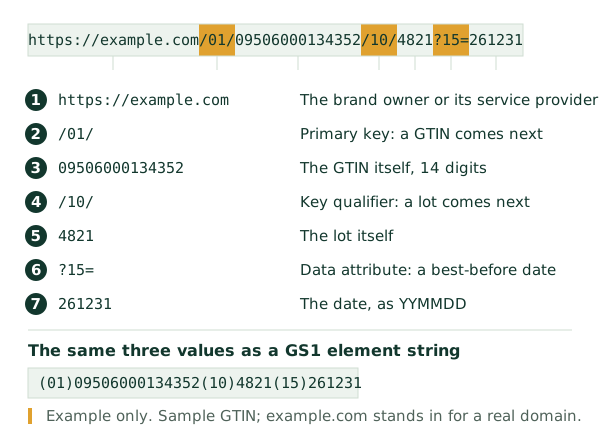
Common Application Identifiers for fresh produce
Table 1 lists the AIs most often met on fresh produce and what each does in a Digital Link address. The first column is the AI, the second its name, the third its role in the address and the last a short example. The list follows the common retail AIs in the point-of-sale guideline and the rules in the General Specifications. [5] [3]
Application Identifiers common in fresh produce and their role in a Digital Link address. Sources: GS1 Digital Link URI Syntax 1.7.0; GS1 General Specifications 26.0; 2D Barcodes at Retail POS Implementation Guideline 1.1.0.
| AI | Name | Role in a Digital Link address | Example |
|---|---|---|---|
| 00 | SSCC (Serial Shipping Container Code), identifies a logistic unit such as a pallet | Primary key, first path segment | /00/{18 digits} |
| 01 | GTIN, identifies a trade item | Primary key, first path segment | /01/09506000134352 |
| 22 | Consumer product variant | Key qualifier, path, directly after the GTIN | /22/{value} |
| 10 | Batch or lot number | Key qualifier, path, after the GTIN | /10/4821 |
| 21 | Serial number | Key qualifier, path, after the GTIN | /21/{value} |
| 11 | Production date (YYMMDD) | Data attribute, query item | ?11=261201 |
| 13 | Packaging date (YYMMDD) | Data attribute, query item | ?13=261215 |
| 15 | Best before date (YYMMDD) | Data attribute, query item | ?15=261231 |
| 17 | Expiration date (YYMMDD) | Data attribute, query item | ?17=261231 |
| 310n | Net weight in kilograms (the last digit gives the decimal position) | Data attribute, query item | ?3102=000250 |
| 422 | Country of origin (ISO 3166 numeric code) | Data attribute, query item | ?422=840 |
When more than one key qualifier is used with a GTIN, the order in the path is 22, then 10, then 21. [1] The examples above are illustrations and the dates are samples.
Which barcodes carry it
GS1’s readiness criteria for point-of-sale scanners name three 2D symbols: GS1 DataMatrix (carrying an element string), Data Matrix carrying a GS1 Digital Link URI, and QR Code carrying a GS1 Digital Link URI. [6] A QR Code that carries a GS1 Digital Link URI is the symbol GS1 markets as a “QR Code powered by GS1”. [7] Symbol size, clear margin and print quality are set by GS1 and, for PLU stickers, by IFPA; this primer leaves them to those documents. [3] [9]
Where to learn more at GS1
Start with the GS1 Digital Link overview page, then use Table 2 to find the document for your question. [2]
Where to learn more at GS1, with the version used in this primer.
| Question | Document | Version | Link |
|---|---|---|---|
| What is GS1 Digital Link? | GS1 Digital Link overview | Web page | gs1.org/standards/gs1-digital-link |
| How is the address built? | GS1 Digital Link URI Syntax | Release 1.7.0, Aug 2026 | ref.gs1.org/standards/digital-link/uri-syntax |
| What does each AI mean, and how are symbols specified? | GS1 General Specifications | Release 26.0, Jan 2026 | ref.gs1.org/standards/genspecs |
| What must a scanner or POS system do? | Solution provider 2D readiness | Version 1.0.0, Apr 2025 | ref.gs1.org/sme-guidance/solution-provider-2d-readiness |
| How is 2D introduced at the register? | 2D Barcodes at Retail Point-of-Sale Implementation Guideline | Release 1.1.0, Dec 2025 | ref.gs1.org/guidelines/2d-in-retail |
| How does a web address get redirected? | GS1-Conformant Resolver Standard | Release 1.2.1, Aug 2026 | ref.gs1.org/standards/resolver |
| How should a QR Code powered by GS1 be made? | QR Code powered by GS1, best practices | 2023 | ref.gs1.org, QR Code best practices |
| What is Sunrise 2027? | What is GS1 Sunrise 2027? (GS1 US) | Web page | gs1us.org, Sunrise 2027 |
| What does the produce industry ask of a PLU sticker? | IFPA, Global Implementation Guidance for 2D Barcodes on Fresh Produce PLU Stickers | Aug 2026 | ifpsglobal.com, implementation guide (PDF) |
How to use this primer
- Say the three terms aloud to a colleague: key, Application Identifier, element string. If you can give one example of each, you have the vocabulary.
- Pick one product you pack. Write its GTIN with 14 digits, then its batch or lot, then a date, first as an element string and then as a Digital Link address. Check the order against Figure 1.
- Decide which of the dates in Table 1 your trading partner asks for. If none, the GTIN alone is the minimum IFPA names for PLU stickers. [9]
- Read GS1’s Digital Link page for the symbols, scanners and resolvers behind these identifiers.
Take a printed label and find the batch or lot, the date and the GTIN. Match each to its AI in Table 1.
Open questions the industry is raising
- Which of the date AIs (11, 13, 15, 17) will trading partners ask for on loose produce, and when?
- Who maintains the web address if one is encoded, and for how long?
- How should a batch or lot number be assigned on a PLU sticker printed in advance, when the lot is known only at pack?
References
- GS1 (2026). GS1 Digital Link URI Syntax. Release 1.7.0, August 2026. https://ref.gs1.org/standards/digital-link/uri-syntax/
- GS1 (n.d.). GS1 Digital Link. Web page. https://www.gs1.org/standards/gs1-digital-link
- GS1 (2026). GS1 General Specifications. Release 26.0, January 2026. https://ref.gs1.org/standards/genspecs/
- GS1 (2026). GS1-Conformant Resolver Standard. Release 1.2.1, August 2026. https://ref.gs1.org/standards/resolver/
- GS1 (2025). 2D Barcodes at Retail Point-of-Sale Implementation Guideline. Release 1.1.0, ratified December 2025. https://ref.gs1.org/guidelines/2d-in-retail/
- GS1 (2025). Solution provider 2D readiness. Version 1.0.0, April 2025. https://ref.gs1.org/sme-guidance/solution-provider-2d-readiness/
- GS1 (2023). QR Code powered by GS1, best practices. 2023. https://ref.gs1.org/docs/2023/QR-Code_powered-by-GS1-best-practices
- GS1 US (n.d.). GS1 Sunrise 2027. GS1 US overview page. https://www.gs1us.org/industries-and-insights/by-topic/sunrise-2027
- IFPA (2026). Global Implementation Guidance for 2D Barcodes on Fresh Produce PLU Stickers. August 2026. https://www.ifpsglobal.com/s/2D-Barcode-PLU-Implementation-Guide_FINAL-hgmn.pdf
About this artifact
© 2026 the contributors. Digital Link Identifiers: A Plain-Language Primer is licensed under the Creative Commons Attribution-NonCommercial 4.0 International license. Share and adapt it for non-commercial purposes, with attribution. Attribute the contributors and Supply Chain of the Future. Listing a company, product or tool is not an endorsement.
This is a v0.9 community release from the Supply Chain of the Future (SCOTF) initiative, an industry innovation program. It is shared to support industry learning and is open for comment at hello@scotf.org.